Tourism Information
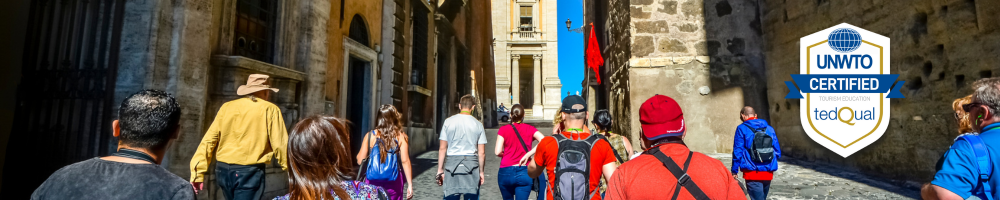
The degree in Tourist Information provides skills for performing duties in the following areas:
- National Guide-Interpreter, welcoming and accompanying tourists, providing information and interpreting heritage;
- Development of products related to digital tourist information for multimedia platforms;
- Tourism promotion for private and public entities.
Employability rate
97.5% (source: http://infocursos.mec.pt/)
Vacancies - 60
Career opportunities
- Accompanying and providing information to tourists throughout the national territory (National Guide-Interpreters);
- Preparing promotional materials about Portugal and promoting them directly and indirectly (tourism promoter);
- Tourism departments of municipal councils and tourism regions;
- Assisting tourists in air, sea, and land transport companies.
Admission requirements - Admission to the Tourist Information course can be obtained through five different routes:
- Through the National Competition for Access to Higher Education, candidates who hold the 12th year of schooling will be required to take entrance exams in one of the following sets of subjects:
In 2026/2027
18 Portuguese or 13 English
or
One of the following sets:
13 English
18 Portuguese
or
12 History of Culture and the Arts
13 English
or
09 Geography
13 English
or
11 History
13 English
or
11 History
18 Portuguese
or
09 Geography
18 Portuguese
Calculation of the application grade: 50% secondary school average + 50% entrance exam grade
Minimum grades: application grade – 95 points | entrance exam grade – 95 points
Courses with preferential access for 2026/2027: 30% of places
Codes:
717 – Tourism Receptionist
A23 – Heritage and Tourism (VC) (Ministerial Order No. 941/2009)
A24 – Heritage and Tourism (VT) (Ministerial Order No. 941/2009)
G12 – Heritage and Tourism (VC)
G25 – Heritage and Tourism (VT)
H25 – Heritage and Tourism (VT)
P91 – Tourism Technician
R47 – Travel Agencies and Transport Technician
R77 – Tourist Information and Entertainment Technician
R92 – Tourism Operations Technician
S59 – Hospitality and Tourism (Ministerial Order No. 846/2007)
T28 – Tourist Information and Entertainment Technician
P92 – Environmental and Rural Tourism Technician
T52 – Environmental and Rural Tourism Technician
G54 – Cultural and Recreational Tourism
H54 – Cultural and Recreational Tourism
-
Through the Special Regimes, which include candidates covered by Decree-Law No. 393-A/99 of 2 October, such as high-performance athletes, nationals of Portuguese-speaking African countries, and military personnel.
-
Through the Special Competitions, which include candidates covered by Decree-Law No. 393-B/99 of 2 October, holders of higher education degrees, and students coming from foreign higher education institutions.
-
Through Access to Higher Education for Applicants Over 23 Years Old, under the conditions set out in Decree-Law No. 64/2006 of 21 March.
-
Through the Special Competition for Access to Higher Education for Holders of Secondary-Level Dual Certification Courses and Specialised Artistic Courses.